The Bolt-On Ceiling
Every legacy vendor has an AI story. None of them have an AI architecture.

Every legacy legal tech vendor has an AI announcement now. A copilot, an assistant, a "powered by GenAI" badge on the roadmap. The demos are good. And almost none of it will change what the product can actually do, because the AI is sitting on top of an architecture that was finished before any of this was possible.
I want to name the thing I keep seeing, because once you see it you cannot unsee it. Call it the feature line.
Below the feature line is the system itself: the data model, the workflow engine, the rules layer, the integration plumbing. In most enterprise legal platforms, that was designed and frozen years ago, in a world with no cloud, no open APIs, and no language models. Above the feature line is where the vendor ships new things. A dashboard. A module. And now, an AI chat box.
Bolting AI on means adding capability above the line. The model can read what the system already exposes and write back into the fields the system already has. What it cannot do is reach below the line and change what the system is. It cannot rewrite the data model when your question needs a shape the schema never anticipated. It cannot make a rigid workflow reason its way around an exception. It summarizes the record. It does not rethink the record.
That is the ceiling. And it is why "we added AI" and "we built for AI" are not two points on the same line. They are different architectures.
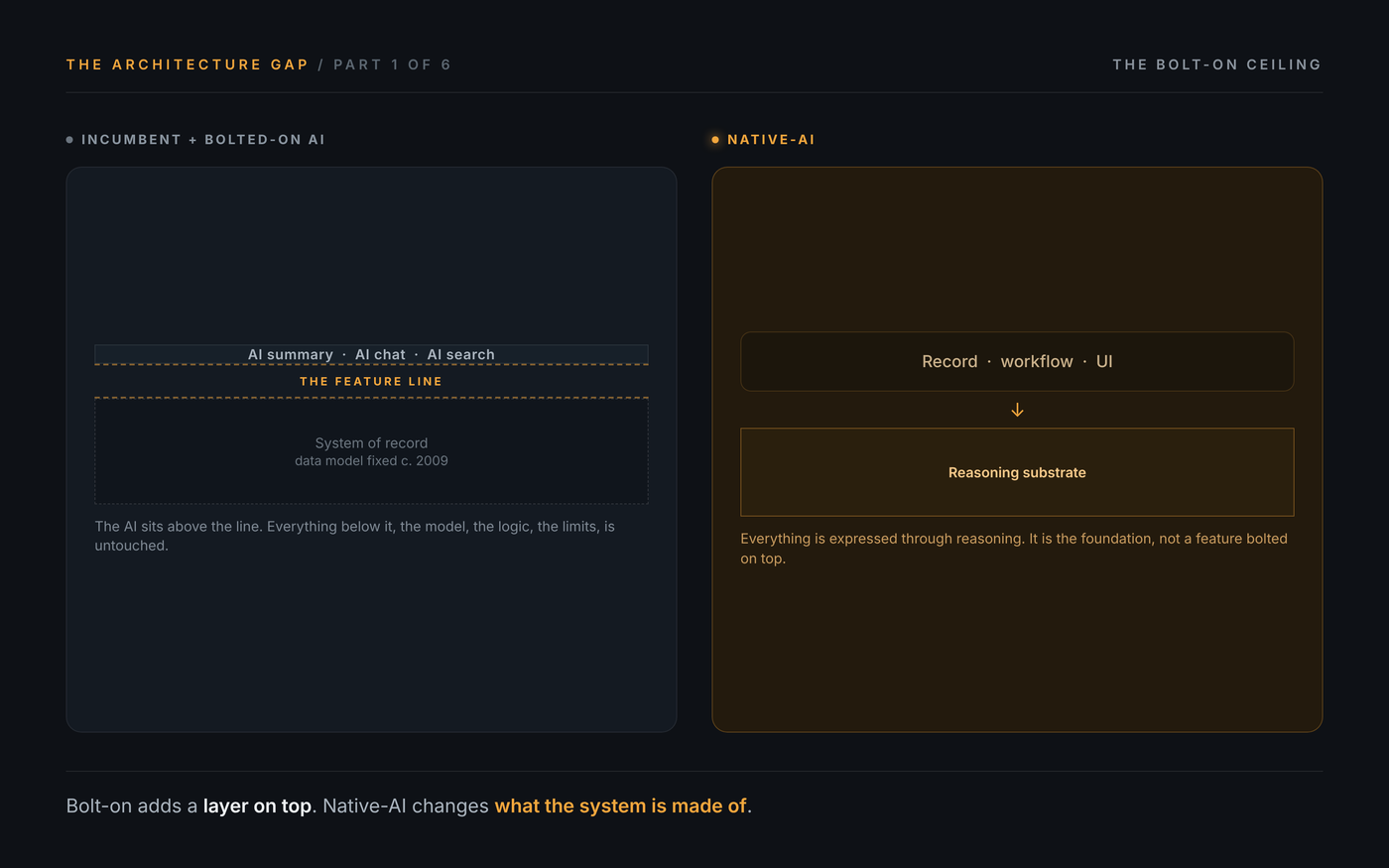
The cleaner way to say it: incumbents built systems of record. The job was to capture legal work into fixed tables so it could be stored, reported, and audited. That was the right goal for 2009. Native-AI systems start somewhere else. Reasoning is the substrate, and the record becomes a byproduct of the system doing the work. The system of record becomes a system of reasoning and action.
I am not saying this from the cheap seats. I spent years on the inside of these platforms, including helping build one of them, and I have led more than a hundred enterprise implementations. The constraint was never the customer's imagination. It was always the architecture underneath. Every ambition had to be squeezed through a data model and a configuration layer that predated the ambition.
Here is the honest part, because a claim like this is worthless without it. Bolt-on is not stupid, and incumbents are not going away tomorrow. They have distribution, they have your data, they have switching costs measured in years, and they have AI features that clear a procurement checklist today. If all you need is a summary button, bolt-on delivers a summary button. The native-AI bet is not that incumbents have no AI. It is that the ceiling matters more than the floor, and that the gap below the feature line compounds while a bolted-on layer cannot close it.
Over the next five pieces I am going to walk the same line through the places it actually shows up: integration, the interface, workflow and rules, analytics and knowledge, and finally trust and governance, which is where the strongest case for the incumbents lives. Each one is the same gap seen from a different angle.
If you run a legal department, the test is simple. The next time a vendor shows you their AI, ask what happens below the feature line. Ask whether the thing you just saw changed the architecture, or just decorated it.