Answering the Black Box Objection
The strongest case for bolt-on AI is safety and auditability. Taking it seriously.
Everything I have argued across this series has an obvious rebuttal, and it is the best argument the incumbents have. It goes like this. A rigid system is a system you can trust. The rules are explicit. The workflow is deterministic. You can audit every step and defend it to a regulator. A reasoning system, by contrast, is a black box. It is powerful, and you cannot see what it did.
If I were defending an incumbent platform, this is the ground I would fight on. And I would be right that the objection is real. In legal, being powerful is not enough. You have to show what happened, prove privilege was protected, show who could see what, and explain a decision months later when someone challenges it. An answer you cannot trace is not an asset. It is a liability.
So let me take the objection seriously instead of waving it away.
The black box fear assumes that reasoning and explainability are opposed. They are not, if the system is built for it. A native-AI platform done right does not just hand you an answer. It shows its work: the sources it pulled, the comparisons it made, the content it excluded and why. Pulled fourteen invoices on this matter. Compared them to the 2025 rate card in the engagement letter. Found three timekeepers above the agreed rate. Excluded privileged content from the summary. That is not less auditable than a rigid rule. It is more, because the trace is the reasoning itself, in language, rather than a log of which stored procedure fired.
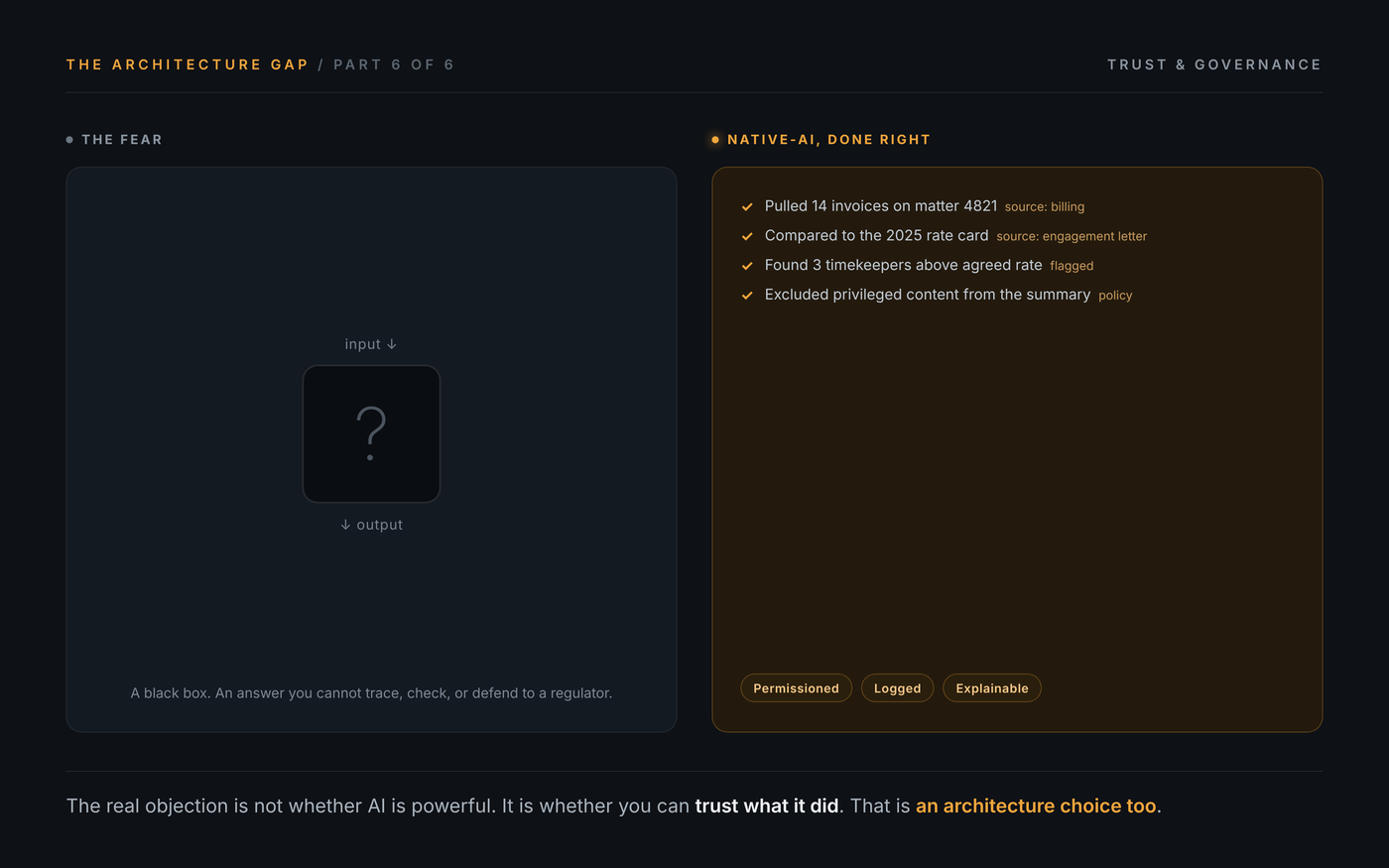
The governance questions do not disappear. They move. Permissioning: who is allowed to ask what, and does the system honor it at the data layer and not just the interface. Logging: is every action recorded in a way you can replay. Explainability: can a human follow the chain and challenge any link. These are architecture choices, and a native-AI system has to make them deliberately and prove them. The real difference is that in a bolted-on system the AI often sits outside the permission and audit model that governs the rest of the platform, because it was added later. In a native system, governance can be part of the substrate, the same way reasoning is.
Here is the honest concession, and it is a real one. This is the hardest thing to get right, and it is where a careless native-AI vendor will do damage. Trust is earned, not claimed, and a legal department is right to demand proof instead of a promise. If a vendor cannot show you the trace, cannot show you the permission model, cannot show you the log, then the black box objection stands and you should walk.
But the objection is an argument for doing native-AI carefully. It is not an argument for staying on an architecture that cannot reason at all. The question is not whether you can trust a system that reasons. It is whether you can trust one that still cannot answer the question you actually have.
That is the architecture gap, walked end to end. Configuration, interface, workflow, rules, analytics, and trust. The same gap every time, because it all comes from the same place: whether reasoning was bolted on at the end, or built in from the start.