The Question Nobody Scripted
From canned reports over fixed tables to reasoning across everything.
Ask your current legal platform a question it was not built to answer. "Which outside counsel quietly raised their blended rate this year, on which matters, and what did it cost me?"
In an incumbent system, that is a project. Export the invoices. Build the pivot. Find last year's rate card in someone's inbox. Normalize the timekeeper titles that three firms spell three different ways. Two weeks later you have a number, and it is already stale.
I used this example to open this whole conversation, and it belongs here, because analytics is where the architecture gap is most visible to the person signing the checks.
The reason it is hard is not that the data is missing. It is that incumbent analytics can only reach what was modeled in advance. Reporting runs over a fixed schema, a set of fields and cubes someone defined at implementation. Any question that fits those fields is a canned report. Any question that does not is an export, or a services engagement, or a quarter in the BI backlog. A bolted-on AI can draw you a prettier chart, but it draws it over the same fixed schema. It cannot reason over what the schema never captured.
And most of what matters in legal was never captured in the schema. The rate card is in an engagement letter. The scope change is in an email. The reason a matter blew its budget is in the documents, not the fields. Incumbent analytics treats all of that as attachments, inert content clipped to a record, invisible to the report.
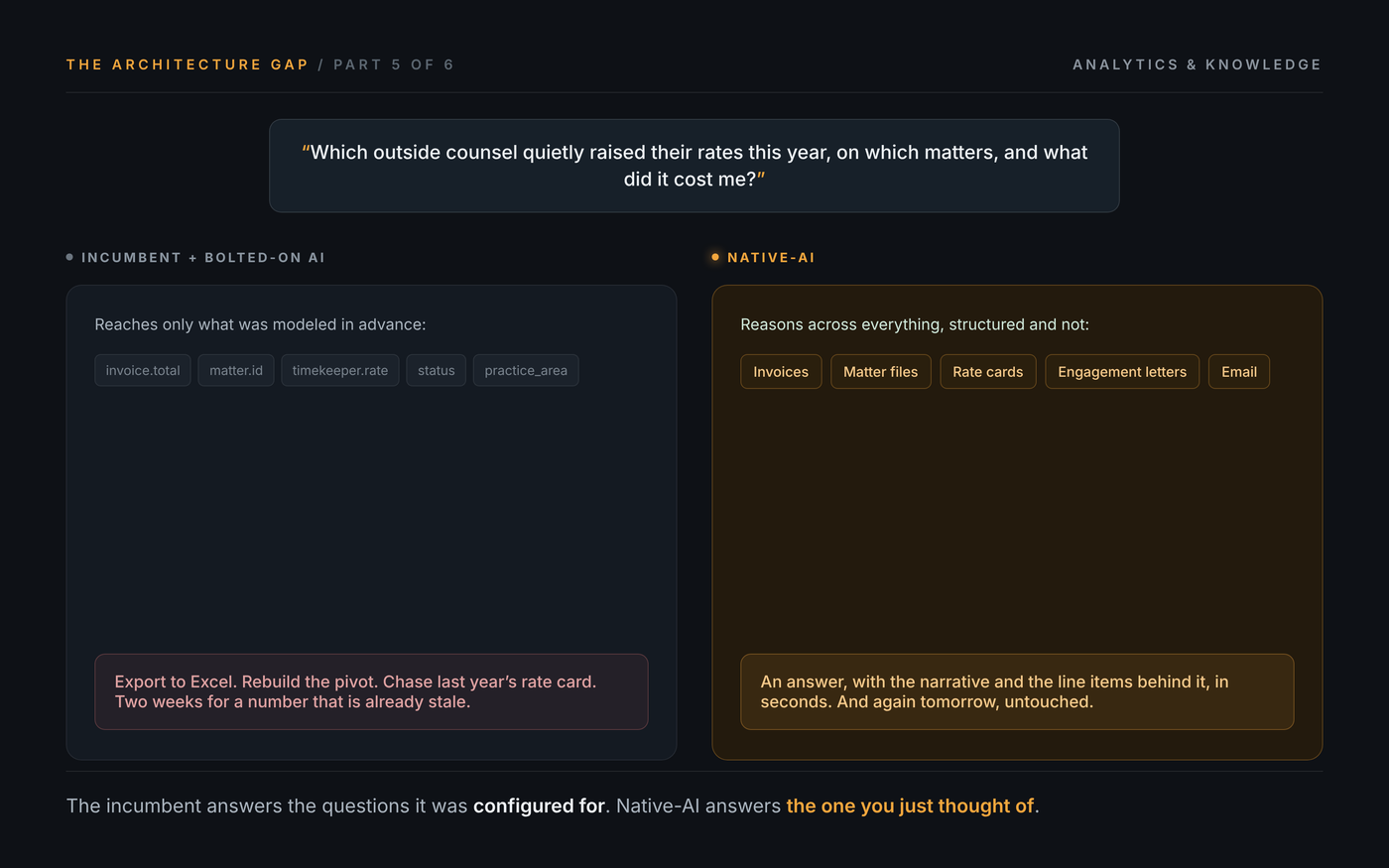
Native-AI reasons across both. Structured and unstructured together: invoices and matter files and engagement letters and email, as one body of knowledge. The question you did not predefine is just the next thing you ask, and the answer comes back with the narrative and the line items behind it, not just a number. Then it does it again next quarter without anyone rebuilding the pivot.
This is the clearest payoff of putting reasoning at the foundation. Analytics stops being a reporting module you query within its limits and becomes a conversation with everything the department knows.
With that freedom comes an obligation. A system that will answer any question can answer confidently and still be wrong, and in legal that is dangerous. The answer has to be traceable to its sources, and the user has to be able to check the work. Which is exactly where this series goes next, and last.