The Chatbot in the Corner
Why bolting a chat box onto a 2009 interface leaves you with two systems fighting.
Look at where the AI lives in most legal platforms today. It lives in a panel. A little chat box docked to the side of a screen that was designed for data entry.
That placement is not a design choice. It is an admission. The primary interface is still what it always was: tabs, grids, forms, and a left-hand navigation tree you learned over months. The AI is a guest in that house. The moment you step out of the chat box you are back in the filing cabinet, and you still have to know where everything is.
So you end up running two mental models at once. One is the old spatial model, where work means navigating to the right screen and filling in the right fields. The other is the new intent model, where work means asking for what you want. The two do not blend. They sit side by side and fight, and the user pays the tax of switching between them all day.
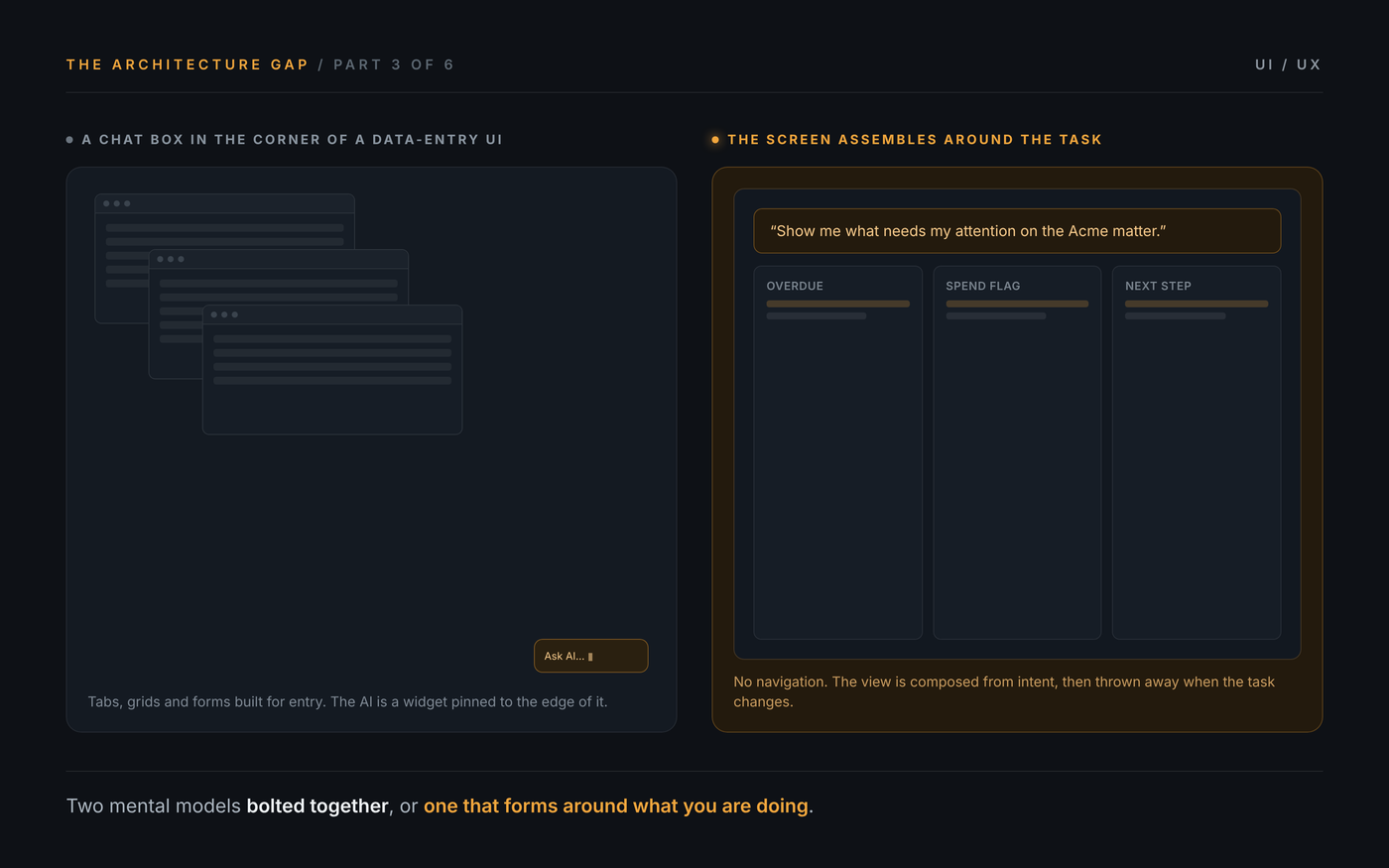
Native-AI starts from the intent model and lets the interface follow. You say what you are trying to do, and the view assembles itself around that: the three things overdue on the Acme matter, the spend that looks off, the next action waiting on you. When the task changes, the view is composed again. There are fewer screens to learn because the screen is an output, not a fixed set of pages you memorize.
This sounds cosmetic. It is not. A form-and-grid interface is the visible shape of the data model underneath it. A screen exists because a table exists. When every question has to be answered by navigating to a pre-built screen, you can only ask the questions someone already built a screen for. That is the feature line again, wearing a UI.
Think about onboarding a new lawyer onto one of these systems. Weeks of training on where things live. Which tab holds accruals, how to raise a matter, where conflicts sit. Now imagine the same lawyer typing what they need and getting a view built for it on the spot. The learning curve is not flattened. It is mostly deleted.
In fairness, there is real value in a stable, predictable interface. Power users build muscle memory, and a screen that reassembles itself can feel ungrounded if it is done badly. Consistency is something native-AI has to earn, not assume. But a chat box bolted onto a 2009 screen is not the answer to that. It is two compromises stacked on each other.
The interface is where the architecture gap is most physical. You can feel it in your hands every time you leave the chat box and go hunting for a tab.