Rules as Code, or Rules as English
From brittle state machines and hand-coded conditions to goal-directed execution.
Every enterprise legal platform runs on two things most buyers never look at closely: a workflow engine and a rules engine. They are where the policy of your department actually lives, and they are where the old architecture shows its age most clearly.
Workflow first. In an incumbent system, a workflow is a state machine you draw in advance. A matter moves from intake to assignment to approval to close, box to box, arrow to arrow. It works beautifully for the path you anticipated. The problem is the case nobody drew. The urgent matter that has to skip a step. The approval that needs a condition no one mapped. The exception that does not fit the diagram. When reality does not match the flowchart, the flowchart wins, and a human routes around the system in email and spreadsheets. The workflow engine becomes the thing people work despite.
Rules are worse, because legal policy is written in language and the engine only speaks in conditions. Your outside counsel guidelines are paragraphs of nuance. To enforce them, someone has to translate those paragraphs into rigid logic. If timekeeper rate is greater than this, and title equals that, and matter type equals the other, then flag. Most of the nuance does not survive the translation. The guideline said to avoid staffing routine matters with partners except where continuity matters. The rule became a rate threshold. Everyone knows the rule is cruder than the policy, and everyone lives with the gap.
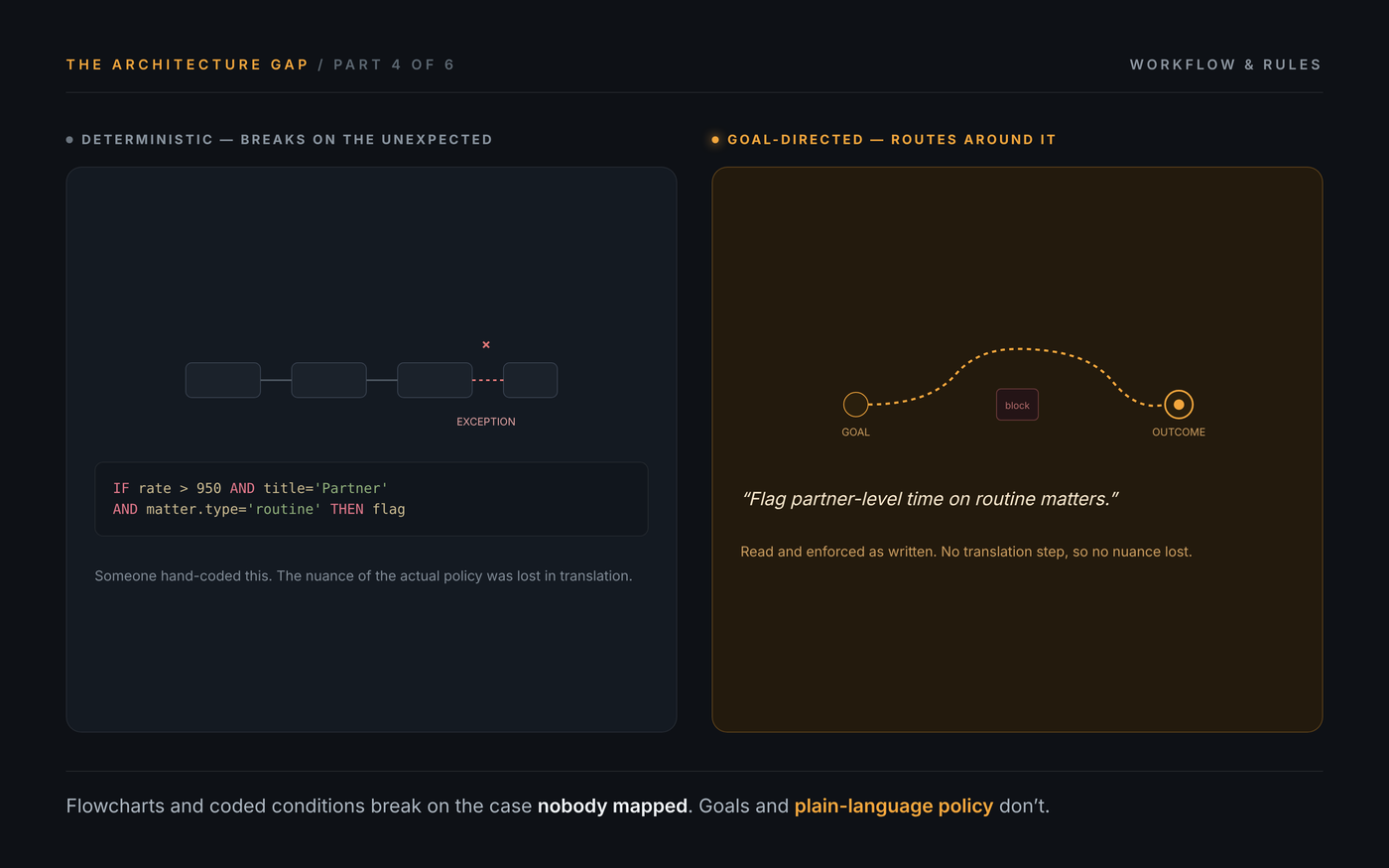
Native-AI changes what a rule is. The system can read the guideline itself and enforce it semantically. "Flag partner-level time on routine matters" is understood as written, with the judgment the sentence implies, instead of reduced to a number. Rules become English. When the policy changes, you change the sentence. You do not change a configuration screen and schedule a regression test.
Workflow changes the same way. Instead of drawing every path, you state the objective and the guardrails, and the system reasons about how to reach the outcome. Goal-directed, not step-directed. The exception that broke the state machine is just another situation to reason about, not a dead end that spills into someone's inbox.
This matters more than it sounds, because the workflow and rules layers are exactly where a bolted-on AI cannot help you. They sit below the feature line. An assistant can summarize a matter. It cannot make a brittle approval chain flexible, because the brittleness is the engine, not the content.
Determinism does have virtues, and I want to be honest about them. In some processes you want a rigid, auditable, identical path every single time, and "the system reasoned about it" is not always what a regulator wants to hear. The answer is not to throw out guardrails. It is to make the guardrails expressible in language and the execution adaptive underneath them. How you prove that balance is the governance question this series ends on.